
The contemporary horizon is dominated by the dizzying rise of Artificial Intelligence—a technology that does not shape up to be a mere mechanical tool, but rather a powerful amplifier of the logic of those who design, train, and deploy it. Every algorithm intrinsically embodies a hierarchy of values: technical neutrality is structurally impossible. Faced with this potent configuration of technological power, humanity finds itself before an eschatological aut-aut (either-or): either allow atheistic-materialistic and technocratic ideopraxes to build a civilization of control and permanent belligerence, or actively cooperate to steer progress toward building the “Civilization of Love and Peace.”
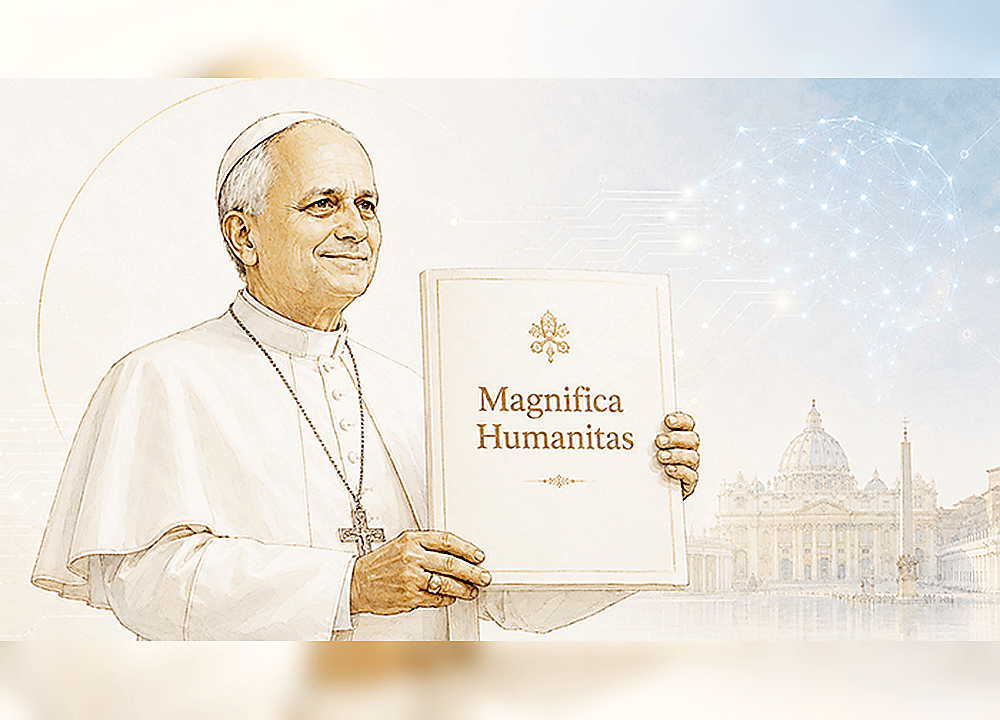
In this scenario, the prophetic magisterium of Pope Leo XIV in his encyclical Magnifica Humanitas (2026) issues a demanding appeal: the civilization of love is not a naive utopia, but a programmatic project that requires concrete structures of fraternity. Europe—by virtue of its centuries-old cultural “genome” born from the synthesis of Greco-Roman, Jewish, and Christian heritages, and its historical maturity gained through the tragic experience of its past failures—stands as the providentially most mature subject to take on this avant-garde responsibility before the international community. Europe is called to be the true “laboratory” of this transition, translating the principles of the Social Doctrine of the Church—dignity, the common good, subsidiarity, and solidarity—into the very architecture of digital and algorithmic systems.
Toward a Theo-Spiritualist Ideopraxis: The Role of Artificial Intelligence
Artificial Intelligence operates by maximizing the efficiency of the logic implicitly expressed by the data of human praxis from which it learns. If integrated into the horizon of individualistic liberal-capitalism or state control, AI inevitably accelerates fragmentation and subjugation. It is therefore imperative to develop a theo-spiritualist and Christic ideopraxis, capable of embracing God-Love as the primary Absolute, guiding innovation from within through lay and secular means.
If informed by this vision, Artificial Intelligence ceases to be a threat and becomes a versatile means to optimize resource distribution, eradicate diseases, and facilitate global education. The European AI Act represents a commendable first institutional effort to “tame digital power” through law, but mere regulatory normativity remains insufficient if it is not supported by an organic, constructive praxis operating from within profane structures.
Structuring Fraternity: From Principles to “Dinontorganisms”
The implementation of Magnifica Humanitas cannot be reduced to applied ethics or a spiritual varnish coated over conflicting structures. It demands the programmatic construction of dinontorganisms—enterprises, universities, communities, and institutions—understood as dynamic historical organisms where the individual is not an alienated cog, but a living part (a person-cell) who finds fulfillment in ontological reciprocity.
To guide this transformation and master historical praxis, the dynamic transcendental of religiosity refracts into four fundamental operational principles:
- Educativity: Training the person-cell to be capable of unveiling the materialistic matrices of current systems and acting as a conscious builder of the civilization of love.
- Constructive Morality: Immanentizing the ontological norm within the objective functions of algorithms, programming AI to optimize integral human development rather than profit or compulsive engagement.
- Functional Sociality: Moving beyond contractualist logic to structure institutional architecture and data governance as a single, cohesive organism of solidarity.
- Missionarity: Sustaining the drive toward universal unification and peace on a global scale, countering the temptations of digital colonialism and transhumanist imperialism.
Europe has an ethical responsibility, proportional to the scale of its own tragic historical arc, to become the “laboratory” for this synthesis, proving to the world that the era of the algorithm can flourish not under the banner of technocratic power, but in the authentic form of human love and freedom.






Leave a Reply