
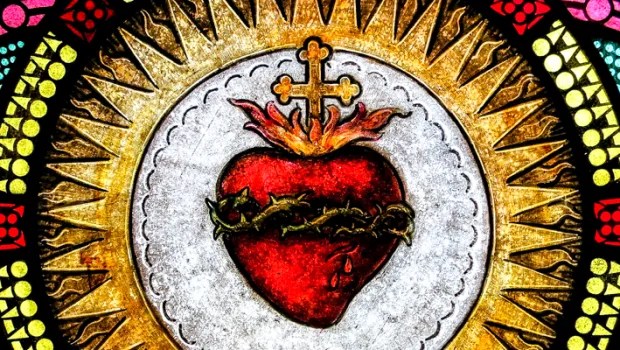
Reflection for the Day of Sanctification of Priests — Solemnity of the Most Sacred Heart of Jesus, June 12, 2026
I. The Starting Point: the Incarnation as Supreme Transfiguration
There is an ancient error that periodically resurfaces in Christian spiritual history, one that misunderstood asceticism tends to reproduce: the idea that purity requires the suppression of desire. It is an error that betrays not only anthropology, but Christology itself. For if there is a place where the question of eros is addressed definitively and irreversibly, that place is the Incarnation of the Word.
When the eternal Son of God assumes human nature in the unity of the divine person — this is the heart of the mystery of the hypostatic union — he does not assume a purified, filtered humanity, stripped of its affective and appetitive structure. He assumes the whole human being: body, soul, intellect, will, sensibility, the capacity to desire and to be moved. The Council of Chalcedon (451) defined that Christ is “perfect in divinity and perfect in humanity, true God and true man,” with “a rational soul and body,” “like us in all things except sin” (DH 301). That final clause — “except sin” — does not exclude desire from Christ’s humanity: it excludes the disorder of desire, not desire itself.
Jesus desires. He feels hunger and thirst. He weeps before the tomb of Lazarus. He is “moved with compassion” — the Greek term ἐσπλαγχνίσθη evokes the bodily depth of being shaken by someone you love — at the sight of the crowd like sheep without a shepherd. He has a beloved disciple. He calls Mary by name in the garden, and she recognizes him by his voice. On the eve of the Passion he declares: “I have eagerly desired to eat this Passover with you” (Lk 22:15). The Heart of Christ is a heart that desires — with the full force of a fully real and fully integral human eros.
The transfiguration of eros does not begin with our asceticism. It begins in the Incarnation: in the flesh of the Word, human eros has already been assumed, purified and ordered from within, not from without. The starting point of the spiritual life is therefore not the attempt to eliminate desire, but to be conformed to the desire of Christ.
II. Eros as the Ecstatic Element: the Sinew of Charity
It is necessary to clarify what we mean by eros, because the word carries an aura of ambiguity that risks distorting the entire argument.
In its deepest and most original meaning, eros is not simply sexuality — that is already its specialized form, and in its disordered version, its degradation. Eros is that force of the soul that makes us go out of ourselves toward something or someone perceived as beautiful and good, that renders the other irreplaceable, that sets us in motion with an energy that the will alone cannot generate. It is what the Greek philosophers called mania divina — the holy madness of love.
Anyone who has truly loved knows what this means. When one is in love, one would do anything for the beloved. One gives up sleep, travels great distances, endures sacrifices that in no other context could be sustained. The beloved is present in thought even when physically absent. Their good becomes more important than one’s own. This is the structure of eros: an energy that shifts the center of gravity of the self toward the other, generating a state of excess beyond the ordinary resources of the will.
Benedict XVI, in Deus Caritas Est, offered an extraordinary definition of this structure: authentic love is “ecstasy,” not “in the sense of a moment of intoxication, but rather as a journey, an ongoing exodus out of the closed inward-looking self towards its liberation through self-giving, and thus towards authentic self-discovery and indeed the discovery of God” (DCE 6). Ecstasy is not the loss of self: it is exodus from a closed self toward a self given in love, and in that gift found more fully.
This ecstatic structure is precisely what eros brings to charity. Without it, charity risks being reduced to a moral obligation fulfilled out of duty, a provision of services without warmth, a justice without love. Charity needs eros as a sinew, as an interior energy that moves and sustains it. Benedict XVI himself states this clearly: “On the other hand, man cannot live by oblative, descending love alone. He cannot always give, he must also receive” (DCE 7). Eros and agape — ascending love and descending love — “can never be completely separated. The more the two, in their different aspects, find a proper unity in the one reality of love, the more the true nature of love in general is realized” (DCE 7).
Eros is therefore the energetic moment of charity: that force which prevents Christian love from becoming abstract, cold, bureaucratic. A priest without eros says Mass. A priest with transfigured eros celebrates Mass. A nurse without eros performs procedures. A nurse with transfigured eros cares for the sick. The difference is not technical: it is a difference in the quality of love.
III. Puritanism as Anthropological and Theological Error
Having established the positive value of eros, it is necessary to confront the opposite error: that of those who understand chastity as the suppression of desire. This error has a precise name in spiritual history: puritanism.
Puritanism, in the broad sense, is not a religious confession but a spiritual attitude: that of those who identify holiness with the absence of desire, who believe that the more one eliminates bodily and affective feeling, the closer one comes to God. It is a dualist anthropology that betrays the realism of the Incarnation.
Benedict XVI dismantles this framework with surgical precision: “The apparent exaltation of the body can quickly turn into a hatred of bodiliness. Christian faith, on the other hand, has always considered man as a unit of body and soul, in which spirit and matter are compenetrated, and in which each thereby experiences a new nobility” (DCE 5). But — and this is crucial — the remedy is not the rejection of the flesh: ” Should he aspire to be pure spirit and to reject the flesh as pertaining to his animal nature alone, then spirit and body would both lose their dignity” (DCE 5).
True continence — authentic chastity — is not affective anesthesia. It is ordinatio, not suppressio. Whoever anesthetizes eros is not chaste: they are simply cold. And a cold heart is incapable of loving fully, neither God nor neighbor. In the Thomistic tradition, chastity is a cardinal virtue that regulates and orders appetite, it does not extinguish it: virtus non destruit naturam, sed perficit. Grace does not destroy nature, it brings it to fulfillment.
To anesthetize eros produces what might be called the frigidity of charity: a service rendered mechanically, without warmth, without real presence to the other, without that capacity to be moved which alone makes the gift of self not an obligation but an act of love. The double life — those who divide a hidden emotional life from public ministry — is a visible laceration. But the half-life — those who in the name of celibacy have progressively ceased to desire, to be moved, to love with their whole self — is an invisible laceration and perhaps a more dangerous one, because it disguises itself as virtue.
IV. The False Continent: Chastity without Self-Gift
There is, however, a third figure, more subtle still, that must be named with honesty. It is that of those who believe themselves to be chaste — and may indeed be continent in the sexual sphere — but who in their relationship with others are not at all for the other, but rather upon the other.
There exists a form of celibacy or sexual abstinence that coexists perfectly with relational manipulation, with the use of others as instruments for one’s own ends, with a spiritual narcissism that exploits the community for personal gratification, that uses the penitent to feel indispensable, the faithful to confirm one’s own image. Those who act in this way are not chaste in the full sense of the term: they are simply continent, and that continence has become a new form of possession.
Chastity, in its deepest truth, is not the absence of relationship but the quality of relationship. It is the capacity to be with the other for the good of the other, without using them as a mirror, without restraining them, without manipulating them for one’s own emotional or institutional needs.
This is the radical truth of chastity: not “having no sexual relations” but “being structurally oriented toward the good of the other.” A priest who uses the confessional to control consciences, a consecrated person who constructs affective dependencies while remaining physically untouchable, a spouse who manipulates their partner while respecting conjugal fidelity — none of these is chaste in the evangelical sense. Because chastity is the free and ordered form of love that gives itself, not the enclosure within which one protects oneself from love.
V. Transfiguration: A Universal Task
The transfiguration of eros into love of service is not an exclusively priestly or religious question. It concerns every form of Christian life, because it concerns the structure of every authentic human love.
For spouses, the path is described at the heart of Deus Caritas Est: “Even if eros is at first mainly covetous and ascending, a fascination for the great promise of happiness, in drawing near to the other, it is less and less concerned with itself, increasingly seeks the happiness of the other, is concerned more and more with the beloved, bestows itself and wants to ‘be there for’ the other. The element of agape thus enters into this love, for otherwise eros is impoverished and even loses its own nature” (DCE 7). Christian marriage is precisely this itinerary of transfiguration: eros that opens, purifies itself, expands until it becomes total fidelity, fruitfulness, communion.
For the consecrated and priests, transfiguration follows a different but structurally analogous path. Erotic energy — the capacity to be moved by the other, to desire their good, to invest one’s entire vitality in relationship — is not simply repressed but redirected and enlarged: not toward one particular person in an exclusive way, but toward every person in the manner of Christ. Spiritual fatherhood, pastoral care, affective presence to the sick and the sinner — all of this requires a living heart, not an extinguished one.
VI. For Priests, Today: Learning from the Heart of Christ
Today, June 12, 2026, the Church celebrates simultaneously the Solemnity of the Most Sacred Heart of Jesus and the Day of Sanctification of Priests. This is not a liturgical coincidence but a pedagogy: the Heart of Christ is the model and source of priestly holiness.
The Gospel of the solemnity places on the lips of Jesus an imperative that is at once theological and spiritual: “Learn from me, for I am meek and humble of heart” (Mt 11:29). Not “obey a rule” but “learn from this heart.” The school of priestly holiness is the contemplation and imitation of the heart of a man who loved fully — with all the eros of an integral humanity — and who transfigured that love into total self-gift.
The Heart of Christ is the place where human eros reached its definitive transfiguration: all the force of desire, assumed in the eucharistic offering, became food for all. The pierced side — from which flow blood and water, symbol of the sacraments — is the image of a heart that closes itself upon no one, and from which life flows ceaselessly.
The grace asked for in the collect of the solemnity for Year A is explicit and beautiful: “Grant that at the school of Christ, meek and humble of heart, we may learn to love one another, so as to dwell in you who are love.” To learn to love: not to presume we already know how, not to settle for a lukewarm or formal charity, but to ask the grace of a truly transfigured heart.
Conclusion: The Prayer of Transfiguration
The fullness of Christian charity — whether in the conjugal or the consecrated state — is never simply the fruit of an asceticism that suppresses, but of a grace that transfigures. One does not arrive at affective maturity by eliminating desire, but by surrendering it, offering it, allowing it to be assumed in the offering as the bread and wine upon the altar.
For this reason, on the Day of Sanctification of Priests, the most necessary prayer that presbyters can make — and with them all the faithful — is this: Lord, give me your Heart. Not a heart that does not desire, but a heart that desires rightly. Not a heart that does not love, but a heart that loves all. Not a heart that does not allow itself to be moved, but a heart that knows toward whom it allows itself to be moved: toward the Father, and toward every brother and sister the Father places at our side.
The transfiguration of eros is true chastity. It is the path that leads, through purification and gift, to that fullness of love of which the Sacred Heart of Jesus is the eternal icon and inexhaustible source.
“Come to me, all you who are weary and burdened, and I will give you rest” (Mt 11:28). Before being able to say this to others, one must have received it. And to receive it, one must present oneself to the open Heart of Christ with all that one is — eros included — so that even that may be transfigured into love.
June 12, 2026 — Solemnity of the Most Sacred Heart of Jesus · Day of Sanctification of Priests
Fr. Riccardo Lufrani O.P.



 Theology and Historical Reality
Leave a comment